
Should You Get That Skin Bump Checked? | Skin Lesion Removal Guide | InSkin Clinic
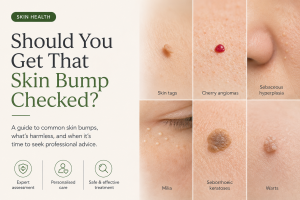
Should You Get That Skin Bump Checked?
A guide to common skin bumps, when they’re harmless, and when it’s time to seek professional advice.
Finding a new bump on your skin can be worrying. Is it something harmless? Will it go away on its own? Or should you have it checked?
The truth is, many skin bumps are completely benign (non-cancerous) and don’t pose any risk to your health. However, some can look very similar despite requiring very different management. That’s why it’s always worth having any new, changing or persistent skin lesion professionally assessed.
At InSkin Clinic, we assess and treat a wide range of benign skin lesions every day. Here’s a guide to some of the most common skin bumps we see.
Skin Tags
Skin tags are soft, flesh-coloured growths that commonly develop in areas where skin rubs together, such as the neck, underarms, eyelids, groin and beneath the breasts. Typically the skin is stretchy and most commonly they have a much smaller attachment than the actual body of the tag.
They are extremely common and become more likely with age, weight gain or pregnancy.
Treatment may be worth considering if they:
- Catch on clothing or jewellery
- Bleed or become irritated
- Affect your confidence
- Are increasing in number
Skin tags are harmless, but many people choose to have them removed for comfort or cosmetic reasons.
If your skin tags are catching on clothing or affecting your confidence, you can learn more about our skin tag removal treatment.
Cherry Angiomas
Cherry angiomas are small, bright red or purple spots caused by tiny blood vessels clustering together beneath the skin.
They often appear on the chest, back, arms and abdomen and usually increase with age. Interestingly stress can also be a factor of these benign growths
Although completely harmless, they can:
- Catch while shaving
- Bleed if knocked
- Become more noticeable over time
- Cause cosmetic concerns
Many patients choose removal simply because they no longer like the way they look.
Find out more about our cherry angioma removal treatment and how we safely remove these harmless vascular lesions.
Sebaceous Hyperplasia
Sebaceous hyperplasia appears as small yellowish or flesh-coloured bumps, most commonly on the forehead, cheeks and nose. Sometimes they appear as a ringed donut in shape.
They’re often mistaken for acne, or even milia but they’re actually enlarged oil glands.
Unlike spots, they won’t disappear with skincare products or acne treatments.
Treatment is usually cosmetic, but many patients choose removal because the bumps become more noticeable over time.
Read more about our sebaceous hyperplasia removal treatment and whether it’s suitable for you.
Milia
Milia are tiny white cysts that develop just beneath the surface of the skin.
They’re commonly found around the eyes, cheeks and forehead.
Although harmless, they rarely disappear quickly on their own and attempting to squeeze them at home can damage the skin or cause infection.
Professional removal is quick, safe and helps minimise unnecessary trauma to the surrounding skin.
Learn more about professional milia removal and why it’s safer than attempting to remove them yourself.
Seborrhoeic Keratoses
Seborrhoeic keratoses are harmless growths that often appear as people get older.
They can vary in colour from light skin colour to dark brown or almost black and often have a waxy or “stuck-on” appearance.
Some remain flat while others become raised. Some become very rough to the touch whereas others remain quite soft. Some will have little white dots (milia cysts)
Many patients request removal because they:
- Catch on clothing
- Become itchy
- Are frequently irritated
- Simply don’t like their appearance
- They grow and more of them are revealing themselves
Our seborrhoeic keratosis removal treatment can safely remove these common benign skin growths following assessment.
Warts
Warts are caused by the human papillomavirus (HPV) and can develop almost anywhere on the body.
Common areas include:
- Hands
- Fingers
- Around the nails (periungual warts)
- Feet (verrucae)
While some warts disappear naturally, others persist for years or spread to surrounding skin.
Treatment may be recommended if they’re painful, spreading, interfering with daily activities or affecting confidence.
Discover more about our wart removal treatments, including options for periungual warts and verrucae.
When Should You Have a Skin Bump Checked?
While many skin lesions are completely harmless, you should always seek professional assessment if a skin lesion:
- Is new and you’re unsure what it is
- Changes in size, shape or colour
- Bleeds without obvious injury
- Doesn’t heal
- Becomes painful or persistently itchy
- Develops rapidly
- Looks significantly different from your other moles or skin lesions
A proper assessment helps determine whether a lesion is suitable for cosmetic removal or whether further medical investigation is needed.
Cosmetic Removal or Medical Concern?
One of the most common questions we hear is:
“Can you just remove it?”
Before removing any skin lesion, it’s important to establish exactly what it is.
Many benign lesions can be safely treated for cosmetic reasons. However, if there is any concern that a lesion may not be benign, we will always advise the most appropriate next step, which may include referral to your GP or a dermatologist. We can also offer an imaging service inhouse whereas images are sent to a dermatologist for their assessment and report.
Your safety always comes first.
Professional Assessment Matters
Many skin conditions can appear surprisingly similar.
What looks like a skin tag may not actually be a skin tag.
What appears to be a harmless mole may require further investigation.
What seems like acne could actually be sebaceous hyperplasia.
Professional assessment removes the guesswork and ensures you receive the most appropriate advice and treatment for your skin.
Thinking About Having a Skin Lesion Removed?
Whether it’s a skin tag, cherry angioma, wart, sebaceous hyperplasia or another benign skin lesion, we’re here to help.
Our experienced team will assess your concerns, explain your options and recommend the most appropriate course of action—without pressure.
Book your consultation today and let us help you feel confident in your skin again.